


Toughness in Diablo 4: How Your Defense Really Works
Armor, Resistances, Damage Reduction and Fortify since Season 11 explained, with the formula, a worked example and an upgrade comparison.
Toughness in Diablo 4 shows how much raw damage your character can take before dying. Raw damage is the damage before any reduction. Behind that number sits a fixed calculation of Life, Armor, Resistances and Damage Reduction. Once you know it, you also understand why you can suddenly drop dead despite high Toughness. This guide gives you the formula, a worked example and clear rules for which defensive upgrade really counts.
Toughness in Diablo 4 at a Glance
Blizzard describes Toughness as the amount of raw damage of each type you can take after all damage mitigation sources. In simplified form, Toughness is built like this:
Toughness = Maximum Life ÷ share of damage that gets throughShare that gets through = (1 − Armor %)
                        × (1 − Resistance % of that damage type)
                        × (1 − Damage Reduction 1)
                        × (1 − Damage Reduction 2) …
| Layer | What it does | Typical sources |
|---|---|---|
| Armor | reduces all damage, Physical and non-Physical | gear, Paragon, skills |
| Resistances | reduce one damage type | affixes, Talismans, Tempering |
| Damage Reduction | reduces what is left once more | aspects, uniques, skills |
| Barrier | absorbs damage before your Life drops | skills, aspects, Barrier Generation |
| Life | the base everything works on | affixes, Paragon, Talismans |
| Healing and Fortify | refill your Life | Life on Hit, potions, Fortify |
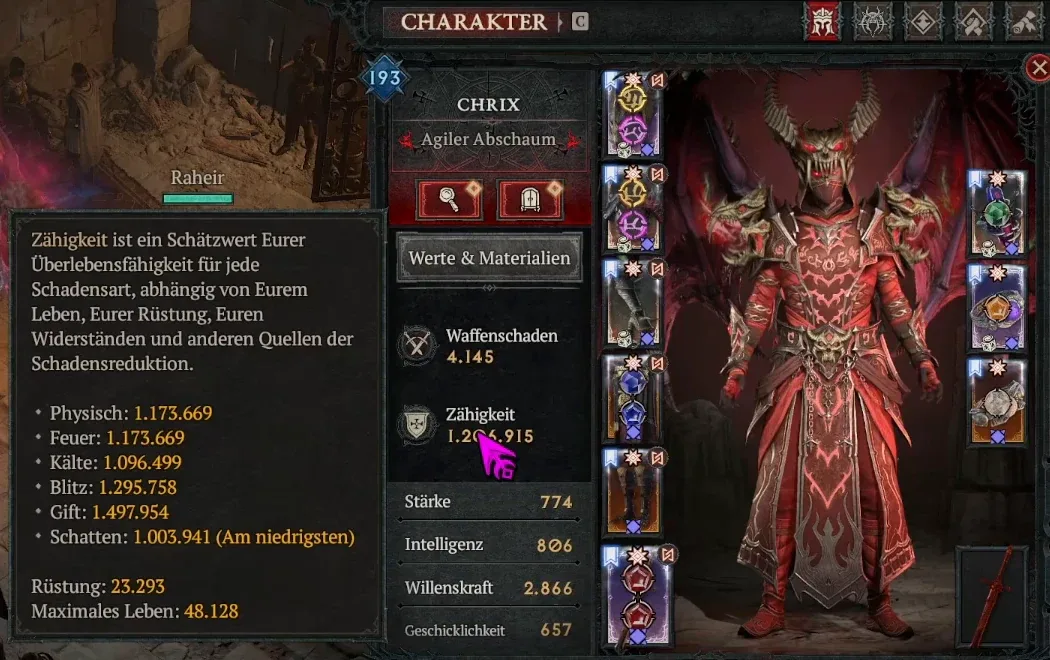
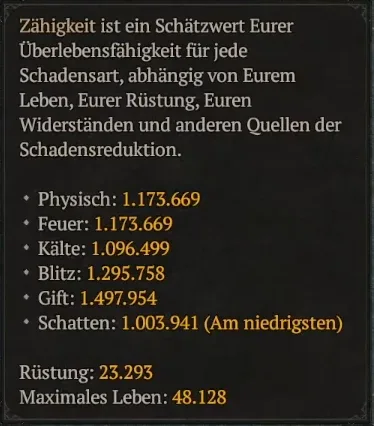
So Toughness is not a protective layer of its own. It only sums up how well your layers work together. The Toughness tooltip breaks your values down by damage type.
How Damage Reaches You
Dodge and Block
A dodge avoids a hit completely. A block reduces the damage of a hit. How much is shown as Blocked Damage Reduction in the tooltip. Both depend on chance, so they do not reliably protect you from a single lethal hit.
Armor: Protection Against All Damage
Since Season 11, Armor reduces all damage, Physical and non-Physical alike. That makes it your most important base layer. Armor has diminishing returns: each extra point adds a little less than the one before. Percentage bonuses such as Total Armor raise your Armor value. They do not raise the percentage reduction directly.
Resistances: Protection Per Damage Type
Resistances only work against their own damage type. There are six of them: Fire, Cold, Lightning, Poison, Shadow and Physical. Physical Resistance has existed as its own resistance since Season 11. Like Armor, Resistances have diminishing returns.
There are two kinds of affixes. All Resistance works on several damage types at once. A single resistance such as Poison Resistance only works on one type, but it is much higher.
Damage Reduction
Damage Reduction mostly comes from aspects, uniques and skills. Many of these only apply under conditions, for example against Close enemies or while you have a Barrier. Several sources do not add up. Each one reduces the damage left after the previous one. Two times 10% therefore gives 19%, not 20%.
Since Season 11, many Paragon nodes and skills no longer grant flat Damage Reduction. Instead they raise your Armor or your Resistances by a percentage.
Barrier
A Barrier is a shield of extra Life. It absorbs damage before your Life drops. You get Barriers from skills, aspects and the Barrier Generation affix. A Barrier only lasts a short time. That is why it helps against damage spikes, not against constant damage.
Life, Healing and Fortify
Maximum Life is the base of Toughness. 10% more Life always means exactly 10% more Toughness. Every reduction works on top of that base.
Fortify works differently since Season 11. It is no longer Damage Reduction but a reserve of Life. Fortify stacks up to your Maximum Life. When you are missing Life, the game gradually converts Fortify into healing. As long as you have any Fortify at all, you count as Fortified. That activates bonuses such as Damage Reduction while Fortified.
Healing comes from potions, Life on Hit, Life on Kill, Life Regeneration and the Healing Received affix. Healing helps against constant damage. Against a single huge hit, only Toughness and an active Barrier help.
Why Armor and Resistances Never Reach 90%
Armor and Resistances are values, not percentages. Blizzard does not publish an official formula. Player measurements show this relationship, though:
Reduction = 90% × value ÷ (value + K)
K = a constant that Blizzard does not publish
The reduction approaches 90% but never reaches it. K is exactly the value that gives you 45% reduction. The table shows what happens when your value is a multiple of K:
| Value | Reduction | Damage that gets through | Works like more Life |
|---|---|---|---|
| 1 × K | 45% | 55% | ×1.82 |
| 2 × K | 60% | 40% | ×2.5 |
| 3 × K | 67.5% | 32.5% | ×3.08 |
| 5 × K | 75% | 25% | ×4.0 |
| 8 × K | 80% | 20% | ×5.0 |
| 9 × K | 81% | 19% | ×5.26 |
| 19 × K | 85.5% | 14.5% | ×6.9 |
Two things follow from this. First, percentage points get more and more expensive. Going from 75% to 80% takes 60% more value. Second, Armor or a Resistance alone can never cut damage below one tenth. That is why you need several layers.
Worked Example: Toughness Step by Step
A character with 30,000 Life, 75% reduction from Armor, 70% Fire Resistance and 20% permanent Damage Reduction from an aspect. An enemy hits them for 100,000 Fire damage.
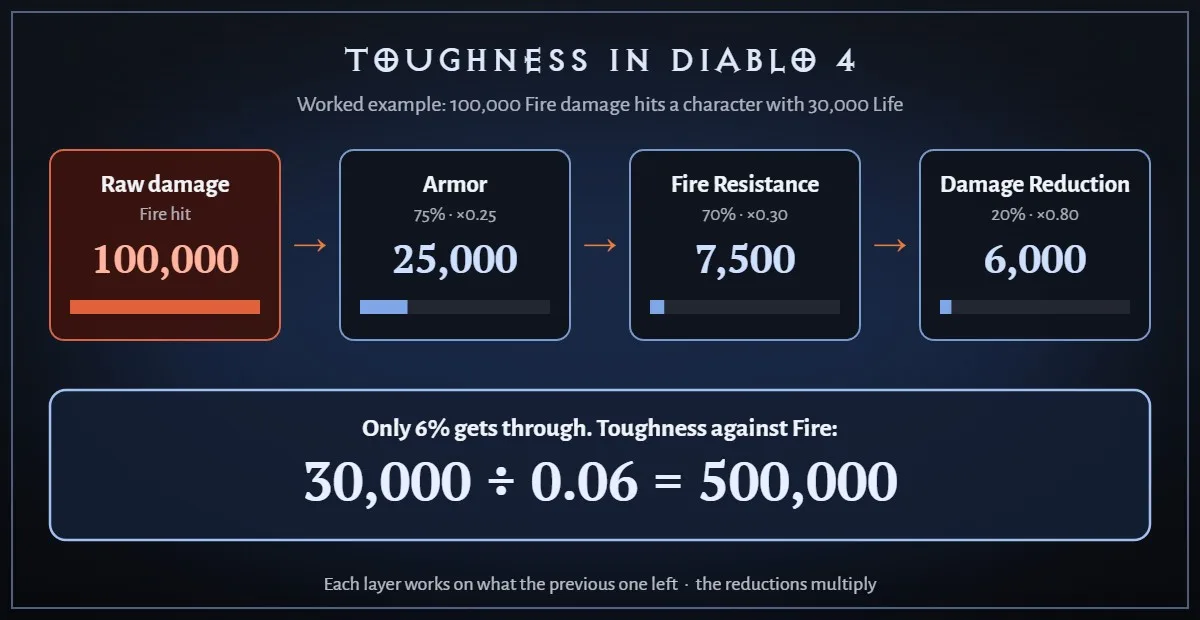
| Step | Factor | Damage afterwards |
|---|---|---|
| Raw damage | 100,000 | |
| Armor 75% | ×0.25 | 25,000 |
| Fire Resistance 70% | ×0.30 | 7,500 |
| Damage Reduction 20% | ×0.80 | 6,000 |
Out of 100,000 raw damage only 6,000 gets through, which is 6%. Toughness against Fire is therefore 30,000 ÷ 0.06 = 500,000. Only a Fire hit of 500,000 raw damage or more would kill the character at full Life. An active Barrier absorbs additional damage on top. Conditional Damage Reduction, for example against Close enemies, usually does not show up in the in-game Toughness. You find your own Armor and Resistance percentages in the Toughness tooltip.
Which Defensive Upgrade Gives the Most?
The example character shows what individual upgrades give you. The table shows how much Toughness against Fire increases. It compares equally large percentage steps, not equally large affixes.
| Upgrade | Toughness afterwards | More Toughness |
|---|---|---|
| Armor 75% → 80% | 625,000 | +25% |
| Fire Resistance 70% → 75% | 600,000 | +20% |
| New 10% Damage Reduction | 555,556 | +11.1% |
| Maximum Life +10% | 550,000 | +10% |
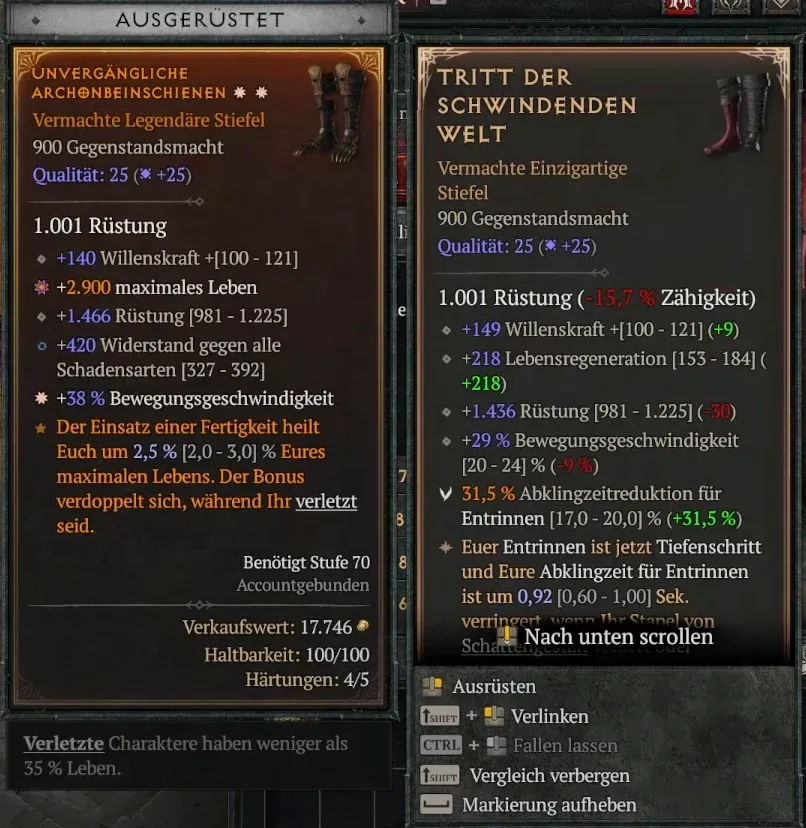
The higher your reduction already is, the more Toughness each extra percentage point of reduction adds. Per point of Armor or Resistance value, however, the gain shrinks, because each percentage point costs more value. In the example, Armor needs about 60% more Armor value to go from 75% to 80%. Fire Resistance needs only about 43% more value to go from 70% to 75%. Life, on the other hand, always keeps the same value. When comparing two items, the change in Toughness is what counts, not the change of a single stat.
How to Use This on Your Gear
- Open the Toughness tooltip and find the damage type with the lowest Toughness
- Close that gap first with single resistances, for example on Charms
- Keep the percentages of Armor and Resistances in a similar range instead of pushing one value to the extreme
- Take Maximum Life where it barely costs you damage
- For Damage Reduction, check whether its condition is really active in combat
- Crafting Guide for Diablo 4: Lord of Hatred Step by Step
- Tuning Prisms in the Horadric Cube Explained
- Talisman in Diablo 4: Seals, Charms & Set Bonuses Explained
Your Weakest Damage Type Decides
A high average Toughness does not protect you if one damage type is open. Take a character with 75% Armor and no other Damage Reduction. Against Fire they have 80% Resistance, against Poison only 40%.
| Damage type | Resistance | Damage that gets through |
|---|---|---|
| Fire | 80% | 5% |
| Poison | 40% | 15% |
A Poison hit gets through three times as hard as an equally large Fire hit. Many characters die exactly at gaps like this, for example to ground effects or elite affixes. Always close the biggest gap first. Since Season 15, single resistances make this especially efficient.
Which Layer Helps Against Which Threat
Not every threat needs the same answer. Look at what kills you and strengthen the matching layer.
| Threat | What helps | What barely helps |
|---|---|---|
| A single huge hit | Life, Armor, the matching Resistance, Damage Reduction, Barrier | healing, Life Regeneration |
| Constant damage such as ground effects | healing, Life on Hit, Fortify | one high Resistance against the wrong type |
| Many small hits at once | Armor, Damage Reduction, dodge | a short Barrier on its own |
| Stun, Freeze, Knockback | Unstoppable | Toughness |
Unstoppable protects you from crowd control such as Stun or Freeze. It does not reduce damage, though. A character who is held in place cannot move out of danger zones. That is why Unstoppable still matters a lot in high Torment tiers.
What Changed for Toughness Since Season 11
Common Toughness Mistakes
- Looking at the average. Neither the average nor the highest value in the tooltip helps you. You die to the damage type with the lowest Toughness.
- Seeing Armor as Physical-only. Since Season 11, Armor reduces all damage.
- Counting Fortify as Damage Reduction. Fortify heals you. It only protects you through bonuses that apply while you are Fortified.
- Adding up Damage Reduction. 20% and 20% give 36%, not 40%. Each source works on what is left.
- Copying fixed numbers from old guides. Caps from before Season 11 no longer apply, and measured constants do not automatically apply to the current patch. Trust the percentages in the game.
Toughness FAQ
What exactly does Toughness show?
Is there a cap for Armor and Resistances?
What is better, Armor or Resistances?
How does Fortify work now?
Why do I die despite high Toughness?
Sources
- Sanctuary Ignites with Itemization & Systems Changes · Blizzard News · accessed October 5, 2026
- Diablo IV Patch Notes (2.5) · Blizzard News · accessed October 5, 2026
- Celebrate 30 Years of Diablo in Season of Hell's Legacy (3.2.1 Patch Notes) · Blizzard News · accessed October 5, 2026
Comments
Login to comment.