
Improve Your Defense in Diablo 4: Survive Higher Torment Tiers
The house principle, 8 pillars of survival and a troubleshooting checklist
In Diablo 4: Lord of Hatred, high damage alone isn't enough; you also need to improve your defense. At higher Torment tiers at the latest, you'll notice: if your defense isn't right, elite enemies, ground effects or certain damage types will simply destroy you despite a good build.
In this guide, I'll show you how to improve your defense step by step: with Life, Armor, resistances and other protective layers. How Toughness is calculated in detail is explained in the Toughness guide.
Why Defense Matters So Much in Diablo 4
Many players focus on damage, Critical Strikes, Attack Speed or strong aspects first. That's understandable, because more damage feels good right away. The problem is:
If you want to hold your own at higher Torment tiers, you don't just need more DPS but above all a stable defensive foundation. Your defense decides whether you survive dangerous situations, keep dealing damage and stop dying to one-shots or ground effects.
What Toughness Means for Your Defense
Roughly speaking, Toughness describes how much damage your character can take in total. Several stats work together:
- Maximum Life
- Armor
- Resistances
- Damage Reduction
- Barrier and Fortify
- Healing
- Movement and control
The House Principle: Defense Explained Simply
Think of your defense like building a house. Every element has its own job:
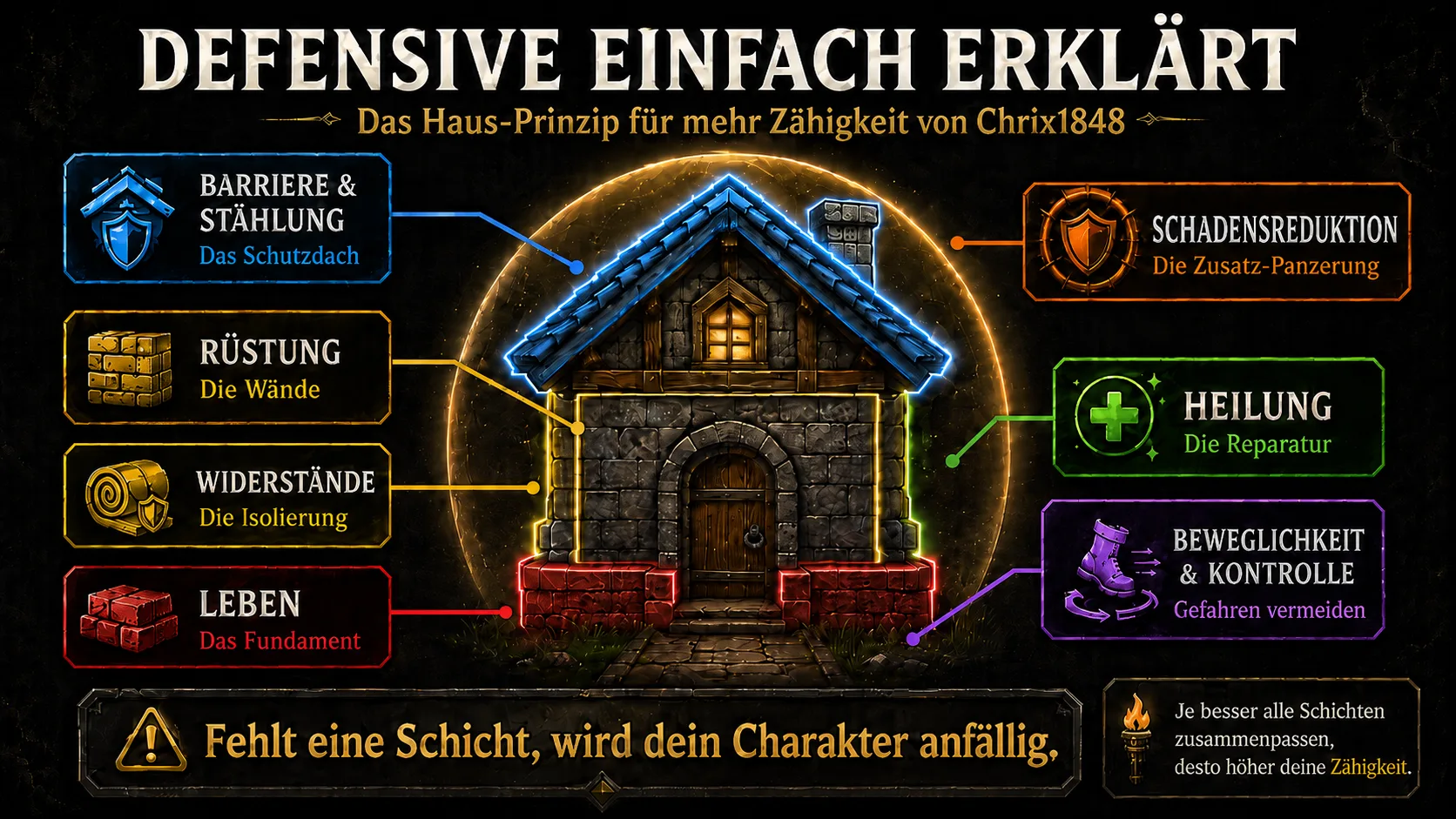
- Life is the foundation: Without enough Maximum Life, your defense collapses quickly.
- Armor is the walls: It reduces incoming physical and non-physical damage and provides a stable base defense.
- Resistances are the insulation: They protect you against specific damage types: Fire, Cold, Lightning, Poison, Shadow and Physical.
- Damage Reduction is extra plating: It helps you take even less damage in dangerous situations.
- Barrier and Fortify are reserves: They give you extra safety before your Life drops to dangerous levels.
- Healing repairs your house: It helps you stabilize during a fight after taking damage.
- Movement prevents the impact: Not every hit needs to be tanked. Sometimes the best defense is simply dodging dangerous attacks.
Improve Your Defense: The 8 Pillars of Survival
1. Build More Maximum Life
Maximum Life is the base of your defense. The more Life you have, the stronger many other defensive layers become (Barriers get bigger, Healing has more room).- Sources: Gear, Paragon boards, Talismans, Tempering and Masterworking.
- Tip: If you often die to single big hits (one-shots), too little Maximum Life is often the main cause.
2. Optimize Armor
Armor is your most important base layer because it reduces physical and non-physical damage. It has diminishing returns, though: every additional point brings a little less than the one before.- Sources: Gear, Paragon, skills, Mercenary bonuses.
- Goal: Reach a solid base reduction so normal hits or heavy melee attacks don't take you out.
3. Balance Your Resistances
The key point isn't having one resistance especially high, but leaving no big weak spot.- If your Fire Resistance is good but Poison or Shadow are weak, you'll still die instantly in certain dungeons.
- Since Patch 3.2.1, single resistances on gear, Talismans and Tempering are 7 times as high as Resistance to All Elements. A targeted single resistance closes a gap much faster.
- Rule: Always fix your biggest weakness first.
4. Secure Damage Reduction
Good sources of Damage Reduction are aspects, uniques, skills and class mechanics. Since Season 11, many Paragon nodes increase Armor or resistances by a percentage instead.- Watch out: Not every reduction always applies. Some effects only work against nearby enemies or elites. Look for reliable sources that are actually active in dangerous moments.
5. Keep Barrier and Fortify Up
These two mechanics are valuable extra layers. A Barrier absorbs damage before your Life drops. Since Season 11, Fortify is a reserve of Life: it gradually converts into Healing, and while you're Fortified, bonuses such as Damage Reduction apply.- Most important here: Uptime. A mechanic is useless if it's rarely active.
6. Secure Healing
Healing is essential for longer fights (for example bosses or Pit pushes).- Sources: Life on Hit, aspects, Life per Second, class-specific mechanics.
- Important: Healing doesn't replace a base defense. Against one-shots, even the best Healing won't help.
7. Adjust Your Mercenary
Check whether your Mercenary (for example Subo or Raheir) can give you defensive benefits. Many players skip this point, even though small bonuses to Armor or resistances from your Mercenary can make the difference in the endgame.8. Use Mobility and Control
Especially at higher Torment tiers, you need to recognize dangerous situations early. If you dodge, you take no damage. Use skills for Unstoppable (against crowd control) and stuns to control the battlefield.Defense Checklist and Troubleshooting
Why do you die despite high Toughness? Go through this checklist step by step to find the problem in your build and improve your defense where it matters:
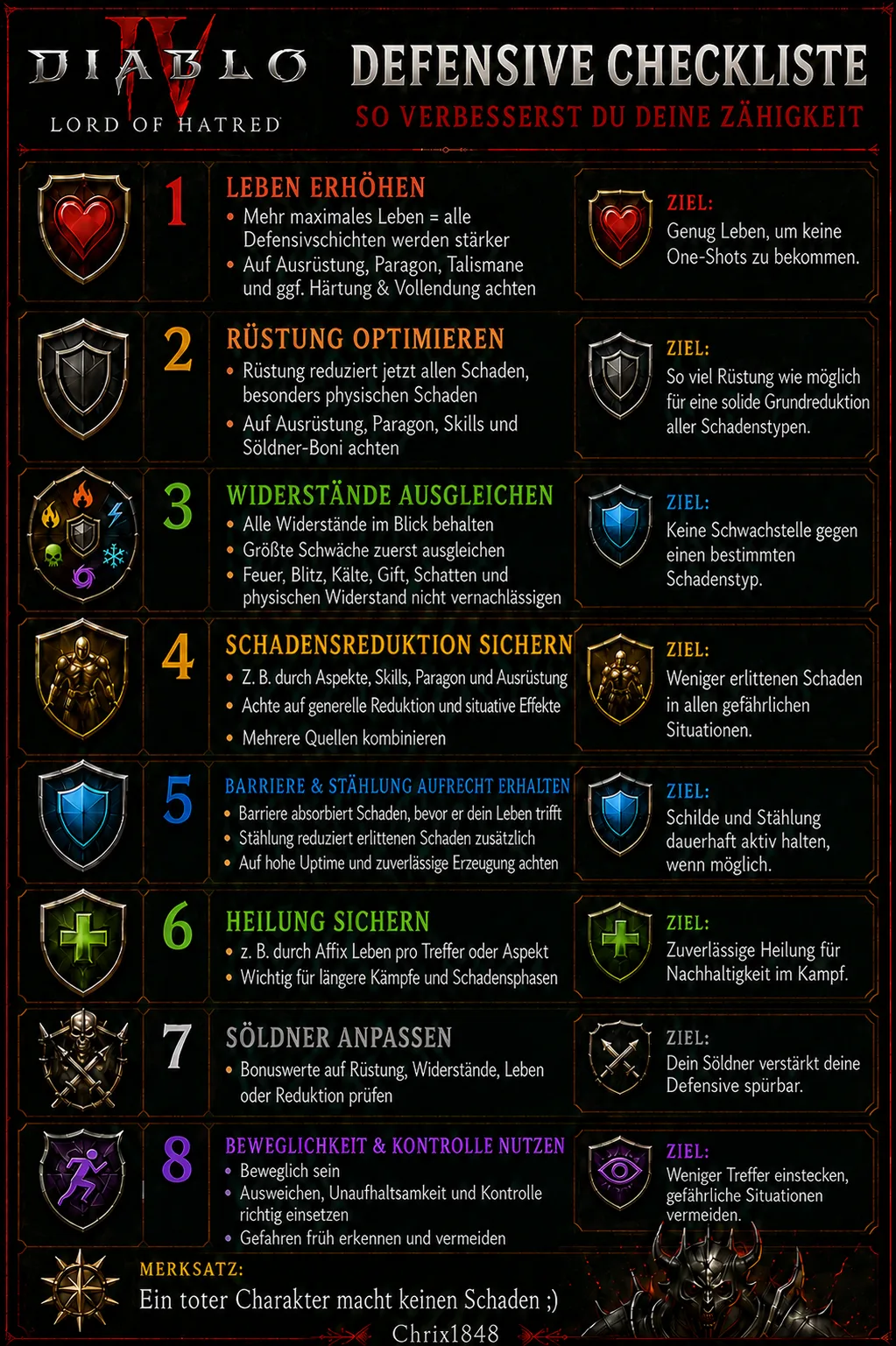
- Check Maximum Life: Do you die to single hits? -> More Life.
- Improve Armor: Taking too much physical damage? -> Push Armor.
- Compare resistances: Which value is lowest? -> Balance it out.
- Add Damage Reduction: Is your base defense not enough? -> Use defensive aspects.
- Barrier and Fortify: Do your reserves keep running out? -> Improve uptime.
- Add Healing: Running out of steam in boss fights? -> Add Life on Hit.
- Check your Mercenary: Missing passive bonuses? -> Adjust Mercenary skills.
- Improve movement: Do you often stand in ground effects? -> Increase mobility.
Video Guide: Improve Your Defense
Check your defense again after every gear change. To see which builds survive well right now, check the tier list, and you can run the numbers for your own setup in the build planner.
See you in Sanctuary! Yours, Chrix1848
Comments
Login to comment.