
Diablo 4 Season 15 Soul Splinters: Effects & Drawbacks
All eight confirmed Soul Splinters compared, including PTR values, suitable playstyles, and the questions still open before release.
Soul Splinters in Diablo 4 Season 15 are special socketable items for Jewelry. Every variant combines a powerful bonus with a drawback or an additional danger. Picking a Splinter solely for its largest number can noticeably weaken your build.
What Are Soul Splinters in Diablo 4 Season 15?
Soul Splinters are seasonal, account-bound socketable items. According to Blizzard's official PTR preview, they can be placed into Jewelry with an available socket. Depending on the variant, they grant an elemental or Physical Resistance, or additional stats.
The second part of each effect matters much more. Critical Strike Chance, Attack Speed, Maximum Life, Damage Reduction, or a large multiplicative damage bonus is paired with a penalty. These drawbacks include increased Primary Resource costs, reduced Maximum Primary Resource, lower Movement Speed, or even increased damage taken.
Blizzard has shown eight different Soul Splinter types so far. The PTR item data contained four distinct quality variants for each type, for a total of 32 items.
How to Get Soul Splinters
Blizzard has not yet revealed the live acquisition methods for Season 15. It is therefore not confirmed whether Soul Splinters drop from regular enemies, seasonal activities, chests, World Bosses, or specific bosses. Any precise farming route would currently be speculation.
On the PTR, testers could obtain them from the vendor Mrak by selecting the “Grant Seasonal Items (Soul Splinters)” boost. This was only a testing feature and does not indicate how the system will be unlocked or farmed on live servers.
Blizzard has also not announced a seasonal quest, minimum level, or special boss required to unlock the system. This section will need to be updated after the Season blog or final patch notes are published.
You can find everything currently known about the season in our Season 15 PTR overview. The PTR item variants are also listed in the D4Guides.gg PTR database.
How Soul Splinters Work
Equipment and Sockets
Soul Splinters are inserted into socketed Jewelry. This normally includes two Rings and one Amulet. If all three items have a socket, up to three Splinters can theoretically be equipped at the same time. Blizzard has not described an additional equipment limit.
The published effects do not distinguish between Rings and Amulets. Each bonus is simply labeled for use in Jewelry.
Combinations and Duplicate Splinters
Different Soul Splinters could be combined on the PTR. For two copies of the same type, Blizzard's PTR known-issues list indicates that both effects are not intended to stack. The stronger version should apply. Due to a PTR bug, the result could instead depend on the order in which the Rings were equipped.
In practice, this means you should not plan around stacking two identical Splinters. Blizzard may still change or clarify the rule before release.
Swapping and Removing Soul Splinters
Blizzard has only confirmed that Soul Splinters can be inserted into sockets. No special binding rule, destruction upon removal, or separate swapping cost has been announced. Blizzard also has not stated whether the Jeweler can unsocket Soul Splinters in the same way as regular Gems.
Until the live version is available, players should not assume that swapping them will be free or that removal will always preserve the Splinter.
Special Case: Leoric's Crown
The new Legacy Unique Leoric's Crown counts as Jewelry according to its tooltip and enhances a Gem socketed into the Helm. Its interaction with Soul Splinters was bugged on the PTR and has not been fully explained by Blizzard. A fourth Splinter in the Helm, or an increase to its special effect, is therefore not confirmed as a final mechanic.
Soul Splinter Rarities and Upgrades
Blizzard lists five rarities: Common, Magic, Rare, Legendary, and Unique. Soul Splinters can be upgraded through the Horadric Cube. The required materials, duplicate items, and Gold costs have not yet been revealed.
The PTR data only shows four concrete effect tiers:
- Magic – Lesser Splinter: typical single Resistance value of 250
- Rare – Splinter: typical single Resistance value of 1,750
- Legendary – Greater Splinter: typical single Resistance value of 2,625
- Unique – Abyssal Splinter: typical single Resistance value of 4,375
Higher rarities improve the positive effect and Resistance value. Most fixed drawbacks remain unchanged. Splinter of the Mother is an exception: at higher qualities, the stun only triggers after touching more enemies. Splinter of Damnation, on the other hand, increases the duration of the Monster Power penalty as its rarity rises.
All Soul Splinters and Their Effects
The values are listed in the following order: Magic / Rare / Legendary / Unique. These are PTR values and are not guaranteed to remain unchanged on live servers.
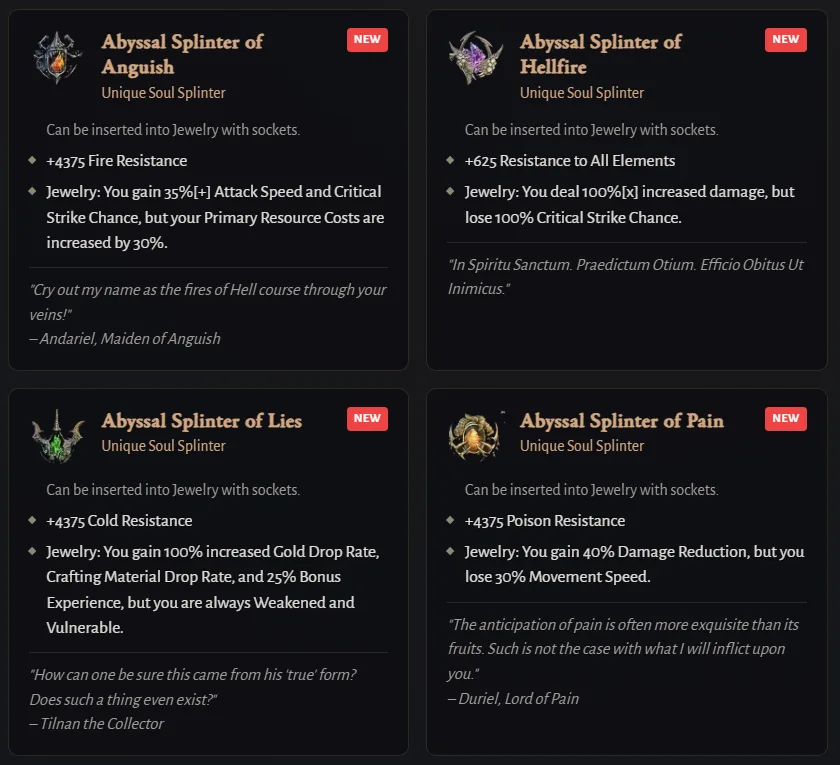
Splinter of Anguish
- Resistance: 250 / 1,750 / 2,625 / 4,375 Fire Resistance
- Positive effect: 15 / 20 / 25 / 35 %[+] Critical Strike Chance and Attack Speed
- Drawback: Primary Resource costs are always increased by 30%.
Splinter of Sin
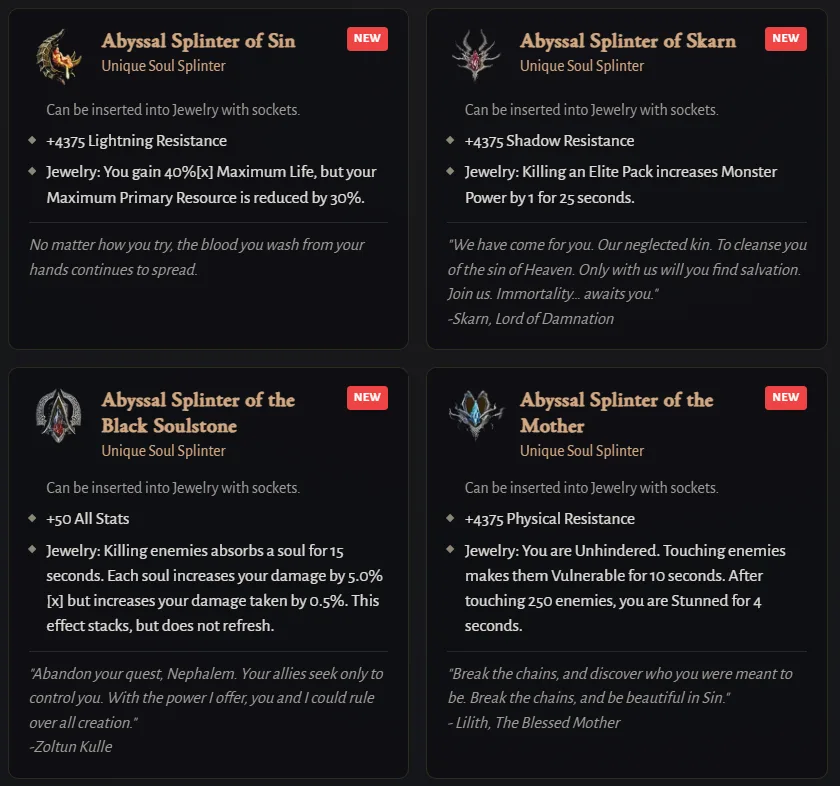
- Resistance: 250 / 1,750 / 2,625 / 4,375 Lightning Resistance
- Positive effect: 10 / 20 / 30 / 40 %[x] Maximum Life
- Drawback: Maximum Primary Resource is always reduced by 30%.
Splinter of Lies
- Resistance: 250 / 1,750 / 2,625 / 4,375 Cold Resistance
- Positive effect: 40 / 60 / 80 / 100% more Gold and Crafting Materials, plus 25% bonus Experience from kills
- Drawback: You are permanently Weakened and Vulnerable.
Splinter of the Black Soulstone
- Value: 7 / 20 / 30 / 50 to All Stats
- Positive effect: Slain enemies grant a Soul for 15 seconds. Each Soul increases your damage dealt by 2 / 3 / 4 / 5 %[x].
- Drawback: Each Soul also increases your damage taken by 0.5%. Gaining new Souls does not refresh the duration of existing stacks.
Splinter of Pain
- Resistance: 250 / 1,750 / 2,625 / 4,375 Poison Resistance
- Positive effect: 10 / 20 / 30 / 40% Damage Reduction
- Drawback: 30% reduced Movement Speed
Splinter of the Mother
- Resistance: 250 / 1,750 / 2,625 / 4,375 Physical Resistance
- Positive effect: You are Unhindered. Enemies you touch become Vulnerable for 10 seconds.
- Drawback: After touching 100 / 150 / 200 / 250 enemies, you are Stunned for 4 seconds.
Splinter of Hellfire
- Resistance: 35 / 250* / 375 / 625 Resistance to All Damage Types
- Positive effect: 40 / 60 / 80 / 100 %[x] increased damage
- Drawback: You lose 100% Critical Strike Chance.
Splinter of Damnation
- Resistance: 250 / 1,750 / 2,625 / 4,375 Shadow Resistance
- Positive effect: The PTR tooltip did not list an additional positive effect.
- Drawback: After killing an Elite pack, Monster Power increases by 1 for 10 / 15 / 20 / 25 seconds.
Soul Splinter Drawbacks Explained
Higher Rarity Usually Does Not Remove the Penalty
The drawbacks of Anguish, Sin, Lies, Pain, and Hellfire remain the same across all documented quality tiers. A higher rarity strengthens the bonus, but it does not turn a Splinter that clashes with your build into a good choice.
Splinter of Anguish, for example, always causes 30% higher Resource costs, whether the Splinter is Magic or Unique. The Unique version provides 35 %[+] Critical Strike Chance and Attack Speed, but it still requires reliable Resource generation.
Splinter of Anguish: Powerful but Resource-Hungry
The combined Critical Strike Chance and Attack Speed bonus suits builds that produce many rapid hits. Those same builds often spend their Primary Resource especially quickly. Resource Generation, Resource Cost Reduction, or skills without high recurring costs can offset the penalty. Whether that is enough must be tested for each specific build.
Splinter of Sin: More Life for a Smaller Resource Pool
Up to 40 %[x] Maximum Life is a major defensive gain. The Splinter becomes problematic for builds whose damage, defense, or triggering mechanics depend on a large Maximum Primary Resource pool. Playstyles with low Resource costs, Basic Skills, or long Cooldowns may find the penalty easier to manage. This is an editorial assessment based on the effect, not a confirmed meta recommendation.
Splinter of Lies: Farming Bonuses with Permanent Risk
Extra Gold, materials, and 25% bonus Experience make this Splinter attractive for fast farming runs. In exchange, Weakened and Vulnerable remain active permanently. The penalty is therefore not limited to individual situations; it follows you throughout every fight.
This trade-off may be worthwhile in content your build already clears safely and quickly. The increased danger matters much more while pushing, fighting difficult bosses, or playing Hardcore. Blizzard's PTR blog does not provide separate numerical values for the two negative status effects, so no additional damage values should be assumed.
Black Soulstone: The Drawback Grows with Every Stack
Every absorbed Soul increases both your damage dealt and your damage taken. With the Unique Splinter, ten active Souls would provide 50 %[x] increased damage dealt, but also 5% increased damage taken. Because the 15-second effects can stack but do not refresh, the Splinter's strength constantly fluctuates.
It is designed for dense groups of enemies. Against a single boss without additional enemies, no new Souls can be generated. Blizzard has not announced a stack limit.
Splinter of Pain: Highly Defensive but Slow
Up to 40% Damage Reduction is the clearest defensive bonus among the Splinters shown so far. Losing 30% Movement Speed can make dodging, fast farming routes, and mechanics with tight timing more difficult. A highly mobile build may compensate for the loss more easily than a slow melee setup.
Splinter of the Mother: Control for a Predictable Self-Stun
Moving through enemies unhindered and making them Vulnerable is particularly useful in dense groups. However, a four-second Stun is long enough to be lethal at high difficulty levels. Higher rarities soften the drawback because more enemy contacts are required before the Stun triggers, but they do not remove it.
Since the counter is tied to enemies touched, fast melee and mobility builds should pay especially close attention. Blizzard has not yet documented whether the counter is visible or how it behaves when changing areas or moving between fights.
Splinter of Hellfire: Only for Builds Without Critical Strike Mechanics
Up to 100 %[x] increased damage sounds universal, but it is not. Losing 100% Critical Strike Chance can remove direct Critical Strike damage and disable Resource, Cooldown, or other effects that require Critical Strikes.
The Splinter is most likely intended for playstyles whose main damage cannot Critically Strike or whose mechanics do not require Critical Strikes. Even then, every other trigger in the build needs to be checked. A general best-in-slot recommendation would be premature before the final values are available.
Splinter of Damnation: Its Benefit Is Not Fully Explained
After every Elite pack killed, Monster Power increases by 1 for a limited time. At first glance, this simply raises the difficulty. The PTR tooltip does not list a separate damage bonus and does not explain whether the increased Monster Power automatically grants more Experience or better loot.
The Splinter appears to be an option for players who deliberately want additional difficulty. Until Blizzard explains the reward side, its risk-versus-reward value cannot be assessed reliably.
Which Soul Splinters Suit Each Playstyle?
The following recommendations are editorial assessments based on the confirmed effects, not a finished Season 15 tier list:
- Critical Strike and Attack Speed builds: Splinter of Anguish, provided Resource generation remains stable.
- Defensive builds: Splinter of Sin for more Maximum Life or Splinter of Pain for Damage Reduction. The key question is whether losing Resource capacity or Movement Speed is easier for the build to handle.
- Gold, material, and Experience farming: Splinter of Lies in content the build can still clear safely despite the permanent debuffs.
- Dense enemy groups: Splinter of the Black Soulstone, because it needs kills to generate damage stacks.
- Contact and movement-focused playstyles: Splinter of the Mother, provided the self-Stun can be controlled.
- Non-Critical Strike damage setups: Splinter of Hellfire, after checking that the build has no Critical Strike-dependent triggers.
- Deliberately increased difficulty: Splinter of Damnation. Its exact reward benefit has not yet been confirmed.
Important Soul Splinter Tips
- Check more than the main effect. Review skills, Aspects, Paragon Nodes, and Uniques that may stop working because of the drawback.
- Do not immediately upgrade every Splinter you find. The exact Cube recipe and its costs are still unknown.
- Use different Splinters for farming and pushing. Splinter of Lies, for example, is not automatically the best choice for the hardest available content.
- Do not rely on two identical Splinters stacking. Blizzard confirmed that the PTR behavior was bugged.
- Do not plan around Leoric's Crown as a fourth Soul Splinter socket yet. Its PTR interaction was unreliable.
- Compare every tooltip against the PTR values in this guide when the season begins. The Common quality and Hellfire Resistance value remain particularly unclear.
- If you want to use an existing character in Season 15, you can find the requirements in our Rebirth guide.
Conclusion
Soul Splinters are not free power. They are build decisions. The strongest effects only work well when their Resource consumption, Movement Speed penalty, Critical Strike restriction, or extra vulnerability fits the rest of the setup. The eight PTR types already show the system's basic trade-offs, but Blizzard still needs to confirm the acquisition methods, upgrade costs, and final values before Season 15 begins.
Frequently Asked Questions
Who wrote this guide?
"Diablo 4 Season 15 Soul Splinters: Effects & Drawbacks" was written by Chrix1848 and published on Sep 5, 2026.
Is the guide still up to date?
Last updated: Sep 5, 2026. Guides are revised when a patch changes the mechanics they describe.
Who is this guide for?
Level: Beginner. It applies to Base Game, Vessel of Hatred, Lord of Hatred.
Comments
Login to comment.